
Book in short
Alice’s Adventures in Wonderland summary
This Alice in Wonderland summary follows Lewis Carroll’s curious girl down the rabbit hole and back. Nothing in Wonderland makes sense, and that is the fun of it.
- Author
- Lewis Carroll
- First published
- Published by Macmillan in London in November 1865, with 42 illustrations by John Tenniel.
- Length
- 12 chapters
- Type
- Children’s fantasy, nonsense literature
- Read the book free
- Project Gutenberg eBook #11 (public domain in the US)
- This summary
- Story in about 2 minutes
The story in short
Alice is sitting on a riverbank with her sister, bored, when a White Rabbit in a waistcoat runs past, checking a pocket watch and saying he will be late. Curious, Alice follows him down a rabbit hole and falls for a very long time.
She lands in a hall full of locked doors. A bottle labelled DRINK ME makes her tiny, and a cake marked EAT ME makes her huge. She cries so much that her tears form a pool, and when she shrinks again she has to swim in it with a crowd of animals. A Dodo organises a race where everyone runs in circles and everyone wins.
Sent by the Rabbit to fetch his gloves, Alice grows so large that she gets stuck in his house. Later she meets a Caterpillar smoking a hookah on a mushroom, who asks her who she is. Alice is no longer sure. One side of the mushroom makes her grow, the other side makes her shrink.
At the Duchess’s house the kitchen is full of pepper, and the baby Alice is asked to hold turns into a pig. The Cheshire Cat appears and disappears, leaving only its grin. It tells Alice that everyone in Wonderland is mad.
At the Mad Tea-Party, the Hatter, the March Hare and a sleepy Dormouse are stuck at six o’clock, always at tea time. They ask riddles with no answers, and Alice leaves in a huff.
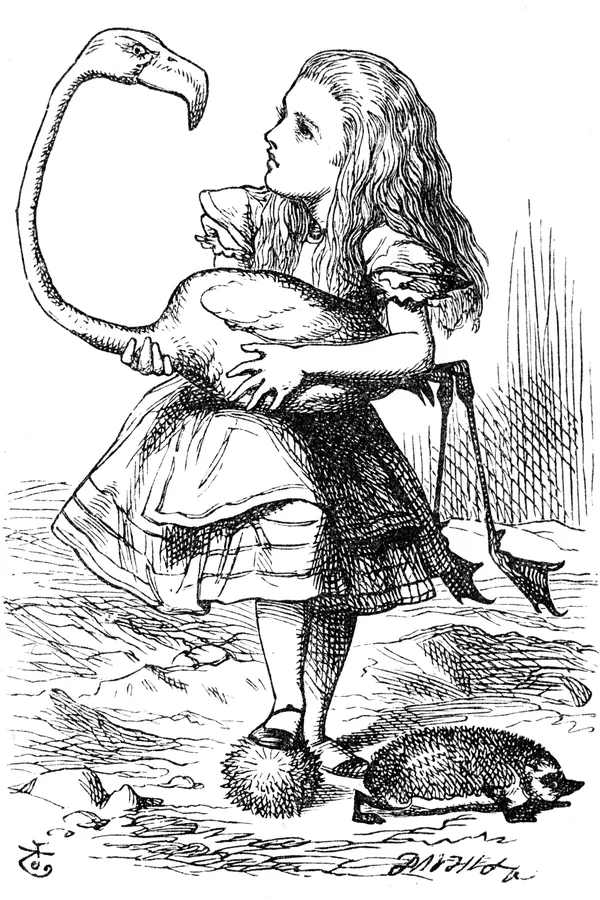
In the Queen’s garden, gardeners who are playing cards paint white roses red. The Queen of Hearts shouts for people to lose their heads, though nobody is really harmed. Alice plays croquet using live flamingos as mallets and hedgehogs as balls. She meets the Gryphon and the sad Mock Turtle, who tells her about his strange school lessons.
Finally there is a trial: the Knave of Hearts is accused of stealing the Queen’s tarts. The evidence is nonsense, and Alice, who is growing again, stands up to the court. “You’re nothing but a pack of cards!” she says. The cards fly at her, and she wakes up on the riverbank with her head in her sister’s lap. It was all a dream.
Spoiler note: this summary tells the whole story, including the ending.
Main characters
- Alice: A curious, polite and stubborn girl who keeps trying to make sense of things.
- The White Rabbit: A nervous rabbit always late for something.
- The Cheshire Cat: A grinning cat who can vanish, leaving only its smile.
- The Mad Hatter: The host of a tea party that never ends.
- The Queen of Hearts: A bad-tempered queen who shouts orders at everyone.
- The Caterpillar: A calm, rude creature who asks Alice who she is.
- The Duchess: A strange noblewoman who finds a moral in everything.
Themes
- Growing up: Alice keeps changing size and asking who she is, much like growing up.
- Nonsense and logic: Carroll, a mathematician, plays with words and rules.
- Curiosity: Alice’s questions drive the whole story.
- Rules and grown-ups: adults in Wonderland make rules that make no sense.
Key lessons from Alice’s Adventures in Wonderland
- Stay curiousAlice’s adventure only begins because she follows the Rabbit. Questions lead to discovery.
- It’s fine not to know who you are yetAlice tells the Caterpillar she has changed so often she is confused. Everyone changes.
- Stand up to bulliesIn the end Alice sees the Queen’s court for what it is: a pack of cards.
- Rules should make senseThe trial shows how silly power looks when it ignores fairness.
- Imagination is a giftThe book shows how much fun a playful mind can be.
Who should read it?
- Children aged about seven and up, read aloud or alone.
- Adults who enjoy word play, puzzles and jokes.
- Anyone who only knows the films and wants the original.
Quotes from Alice’s Adventures in Wonderland
Copied word for word from the public-domain text on Project Gutenberg, with the chapter each line comes from.
and what is the use of a book,
Alice’s Adventures in Wonderland, Chapter 1Curiouser and curiouser!
Alice’s Adventures in Wonderland, Chapter 2Who in the world am I? Ah, that’s the great puzzle!
Alice’s Adventures in Wonderland, Chapter 2we’re all mad here.
Alice’s Adventures in Wonderland, Chapter 6and go on till you come to the end: then stop.
Alice’s Adventures in Wonderland, Chapter 12
If you liked it, read these next
- Little WomenA gentle classic about girls growing up.
- A Christmas CarolA short Victorian story with a dreamlike visit to strange worlds.
- FrankensteinA very different classic that also asks: who am I?
- Great ExpectationsAnother young hero meeting very odd grown-ups.
Frequently asked questions
Who was the real Alice?
Lewis Carroll first told the story on 4 July 1862, during a boat trip on the river near Oxford with the three young daughters of his friend Henry Liddell. One of them was Alice Liddell.
Is Alice in Wonderland a dream?
Yes. At the end Alice wakes up on the riverbank beside her sister and tells her about her curious dream.
Who was Lewis Carroll?
Lewis Carroll was the pen name of Charles Lutwidge Dodgson, a mathematics lecturer at Christ Church, Oxford.
What is the difference between Alice in Wonderland and Through the Looking-Glass?
Alice’s Adventures in Wonderland (1865) is the first book. Through the Looking-Glass (1871) is a sequel where Alice steps through a mirror into a world based on chess.
Explore more
- Classic books about growing upTheme
- Famous book quotesExact quotes from classic novels
- Life lessons from famous booksWhat the classics teach
- Classic books to readA starter list
Sources
- Project Gutenberg eBook #11: full text of Alice's Adventures in Wonderland (plot and every quote checked against it)
- Wikipedia: Alice's Adventures in Wonderland (publication facts)
- Wikipedia: Lewis Carroll
Checked for this page before publishing. Found a mistake? Tell us.
Published 2026-10-27. Last checked 2026-10-27.